Gibraltar company and director search
Search Gibraltar companies and their directors, read their filings and order copies of official documents. The guide below explains the register of Companies House Gibraltar and the law behind it.
127,290 companies and 17,489 directors of Gibraltar, from the records of Companies House Gibraltar. Newest filing received: 25 November 2026.
Searching by name is free. Documents are paid one at a time; no subscription is necessary.
Gibraltar company documents
Search the company, or open a document below and choose the company there. Each document page says what it contains and gives the price and the delivery time before you pay, with pages of a real example where we have one.
- Gibraltar Full Report
Complete company file with profile and copies of available registry filings.
Electronic PDF by e-mail, within 1 business day€260View details - Certificate of Good Standing
Official certificate issued by Companies House Gibraltar confirming that the company is active and up to date with its filings, with its directors, secretary, registered office, capital and charges.
Printed document, sent by courier, up to 2 business days€270View details
Dato Capital is a private company, not Companies House Gibraltar. A certificate or a copy is a document of the register that we obtain for you; a report is compiled by Dato Capital from the register's records.
Gibraltar company information at a glance
Each company receives a registered number when it is incorporated (company numbers).1 Any person may inspect the records the Registrar of Companies keeps and obtain a copy, a certified copy or an extract.1
- Public: the name, number, date of incorporation and type; the memorandum and articles; the registered office; the directors and secretary, with residential address, nationality and occupation; the members and their shares (a collective investment scheme licensed, authorised or deemed authorised under the Financial Services (Collective Investment Schemes) Act 2011, other than a private scheme, need not list its members); the accounts as filed; the charges registered with the Registrar (what is public).1
- Partly public: the beneficial owners are in the Register of Ultimate Beneficial Owners, which has its own Registrar, since 1 September 2026 the Gibraltar Financial Services Commission.5, 10 The public sees their name, month and year of birth, nationality, country of residence and the nature and extent of their interest. Their other details have no public access: the competent authorities, the Commissioner of Income Tax and financial intelligence units can see them, and obliged entities such as banks for customer due diligence (beneficial owners).5
- Changes: a company reports a change of directors or secretary within 14 days, and a change of registered office within 30 days. A private company reports a change of members within 30 days, unless it has notified the Registrar that it is a collective investment scheme. A company with a share capital delivers an annual return every year (filings).1
- Documents: anyone may obtain certified copies, a certificate of incorporation, a company profile and a certificate of good standing. A certificate of good standing is issued only for a company up to date with all its filings (documents and certificates).1, 26, 27
- Status: the register shows the status of a company, for example in liquidation, pending striking off or struck off. The Registrar may strike off a company, other than a public limited company, that has filed no annual return in the previous three calendar years, and may restore it within 10 years (company status).1, 27
Companies House Gibraltar
Gibraltar companies are registered with the Registrar of Companies under the Companies Act 2014. The Minister may appoint the Registrar; failing an appointment, the Registrar of the Supreme Court is the Registrar of Companies (section 420(1)).1 The Minister responsible for finance appointed the present Registrar on 14 May 2026 (Government Notice 287 of 2026).13
The registry is known as Companies House Gibraltar.24 Its three statutory functions are to incorporate and dissolve companies, to examine and hold the documents delivered to it, and to make that information available to the public.25 The same office keeps the registers of limited partnerships, limited liability partnerships, private foundations and business names, and is also the registrar of registered trusts, trade marks and patents.24 The register's name index also covers Gibraltar Economic Interest Groupings.32 The Registrar of Business Names is the person the Minister designates (section 2A(1) of the Business Names Registration Act).20
Documents delivered to the Registrar must be drawn up in English. A version in another language may also be delivered, with an English translation certified as correct (section 424(1) and (2)).1 The Registrar may keep the information in the documents delivered in any form from which it can be inspected and copied in printed or electronic form (section 425(1)).1 The Registrar keeps the paper originals of those documents for 10 years, after which they may be destroyed (section 425(2)).1 The register's guidance of January 2018 says that it makes the documents delivered to it available for public inspection within 24 hours.24 Subscribers to the register's online service can search the electronic files of all active companies registered in Gibraltar since 1931.25 Since 18 February 2026 licensed company formation businesses can apply to register a company online.33
Dato Capital holds 127,290 Gibraltar companies from the register. The newest filing held is dated 25 November 2026.
History
In 1993 the Government decided to hand the day-to-day management of the registry to a private company, and the register's guidance of January 2018 says that Companies House (Gibraltar) Limited has that management.24 The Companies Act 2014 came into force on 1 November 2014.1 It replaced the Companies Act of 1930.2
Types of company
A company is limited by shares when each member's liability is limited to any amount unpaid on their shares. It is limited by guarantee when each member undertakes to contribute a fixed amount on a winding up. It is unlimited when its members' liability has no limit (section 3 of the Companies Act 2014).1
Private limited company (Ltd)
A private company is limited by shares or by guarantee. Its articles restrict the transfer of shares and prohibit invitations to the public to subscribe (section 19).1 Its name ends with "Limited" or "Ltd" (section 2(1)(b)).1 It needs at least one director (section 215) and a secretary (section 216).1
Public limited company (plc)
A public company is limited by shares, or by guarantee with a share capital, and its certificate of incorporation says that it is public (section 4(1)).1 Its name ends with "Public Limited Company" or "plc" (section 2(1)(a)).1 It needs at least two directors (section 215).1 It may not commence business until its allotted share capital reaches GBP 20,500 (section 135).1
Guarantee and unlimited companies
A company formed for commerce, art, science, religion, charity or another useful object, which pays no dividends, may be licensed by the Minister to omit "Limited" from its name (section 28(1)).1 A guarantee company and an unlimited company may have a share capital (section 3(5) and (6)).1
Protected cell companies
Protected cell companies have existed since 1 November 2001. A protected cell company is a single legal person that can create cells, and a cell is not a separate legal person (section 3 of the Protected Cell Companies Act 2001).17 Since 30 July 2026 they may issue tokenised shares and keep share registers on distributed ledger technology.18
Partnerships and foundations
A limited partnership has at least one general partner and at least one limited partner (section 5(1) of the Limited Partnerships Act 2021). The general partners are jointly and severally liable for its debts and obligations; a limited partner is liable only up to the amount they contributed or agreed to contribute (section 5(3) and (4)). The partnership is formed on its registration (section 6(1)).14 Its general partners elect, once and for all, whether it has legal personality (section 10).14 A limited liability partnership is a body corporate separate from its members (section 3 of the Limited Liability Partnerships Act 2009).16 Private foundations are entered in the Register of Foundations, kept by the Registrar of Companies (sections 11 and 12 of the Private Foundations Act 2017).19
Foreign companies
A foreign body corporate with a place of business in Gibraltar registers under Part XII within one month (section 432).1 A body corporate incorporated outside the United Kingdom and Gibraltar that opens a branch in Gibraltar registers it under Part XIV within one month (sections 443 and 445).1 Companies may also re-domicile into and out of Gibraltar under Part XIII (section 442 and the Companies (Re-Domiciliation) Regulations 1996).1, 21
Company numbers
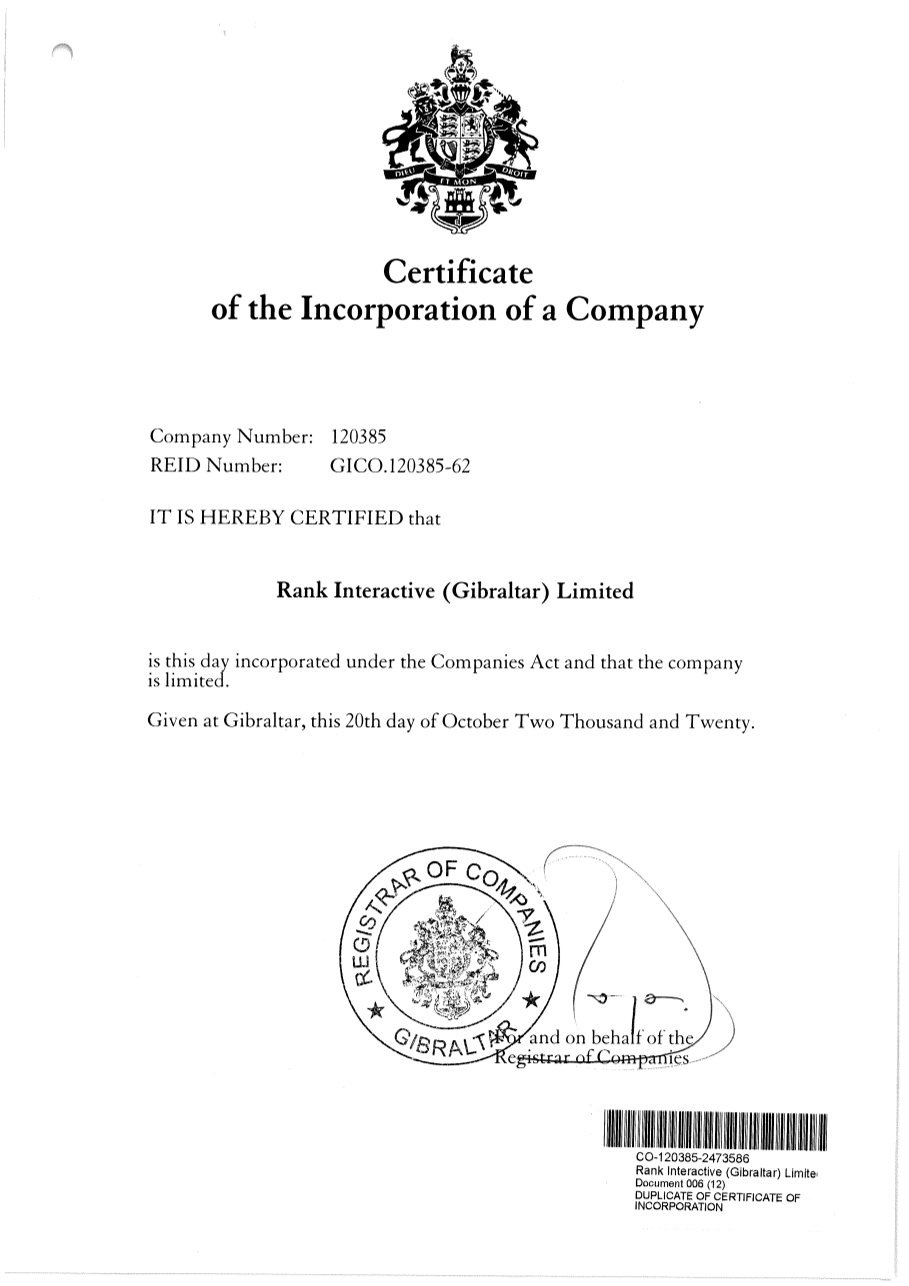
Each company receives a registered number when it is incorporated. The certificate of incorporation states the name, the registered number, the date of incorporation and the type of company (section 15(2) of the Companies Act 2014).1 The certificate is conclusive evidence of registration (section 15(4)).1
A company shows its place of registration, registered number and registered office on its letters, order forms and website home page (section 180).1 The register's name index lists each company with its incorporation number, date of incorporation, status, type and the date of its last annual return filed.32
A branch registered under Part XIV receives its own branch number (section 444(2)). If the Registrar changes a branch number, the old or the new number may be used on business letters and order forms for three years (section 444(4) and (5)).1
Many Gibraltar companies have similar names. The register asks for the full name and, if possible, the number with every profile request.27
What is public
Any person may inspect the records the Registrar keeps and obtain a copy, a certified copy or an extract (section 427(1) of the Companies Act 2014).1
The table describes the information normally obtainable from Companies House Gibraltar and from the Register of Ultimate Beneficial Owners. The legal basis gives the law and its year; the year of a law does not show when an item first became public.
Scroll sideways to see all columns.
| Item | Public | Legal basis |
|---|---|---|
| Name, number, date of incorporation, type | Yes | Companies Act 2014, sections 15 and 4271 |
| Memorandum and articles | Yes | Companies Act 2014, sections 9, 26 and 4271 |
| Registered office | Yes | Companies Act 2014, sections 178 and 4271 |
| Directors and secretary: names, usual residential address, nationality and occupation (for a corporation, its name and registered or principal office) | Yes | Companies Act 2014, sections 222, 223 and 4271 |
| Members and their shares | Yes, through the annual return and the returns of members. A collective investment scheme licensed, authorised or deemed authorised under the Financial Services (Collective Investment Schemes) Act 2011, other than a private scheme, need not list its members in its annual return; a company that has notified the Registrar that it is a collective investment scheme need not report changes of members (shareholders) | Companies Act 2014, sections 154, 188(4) and (6) and 4271 |
| Share capital and allotments | Yes, through the annual return and the returns of allotments (a company that has notified the Registrar that it is a collective investment scheme need not make returns of allotments) | Companies Act 2014, sections 86, 188(7) and 4271 |
| Annual accounts | Yes, as filed by mainstream companies (limited companies other than non-profit companies, licensed banks and licensed insurers). A small company may file only its balance sheet; a company that is not small may keep its directors' report available to the public at its registered office instead of filing it | Companies Act 2014, sections 237(2), 254(5) and (6) and 4271 |
| Mortgages and charges registered with the Registrar | Yes, for a fee for each inspection | Companies Act 2014, section 172(3)1 |
| Liquidation and striking off | Yes | Companies Act 2014, sections 376, 411 to 413 and 4271 |
| Beneficial owners: name, month and year of birth, nationality, country of residence, nature and extent of the interest | Yes, on request to the Registrar of Ultimate Beneficial Owners, unless the Registrar refuses access in exceptional circumstances | Register of Ultimate Beneficial Owners, Nominators and Appointors Regulations 2017, regulations 26(1)(d), 26(4), 31 and 325 |
| Beneficial owners: full date of birth, address and the other details held | No public access; access for the competent authorities, the Commissioner of Income Tax and financial intelligence units, and for obliged entities within customer due diligence | Regulations of 2017, regulations 6(4) and 26(1) to (4)5 |
| Entries on express trusts | No public access; no access for obliged entities | Regulations of 2017, regulation 26(7)5 |
| Nominators of nominee shareholders, appointors of nominee directors | No public access; access for the competent authorities and financial intelligence units | Regulations of 2017, regulations 26ZA and 26ZB5 |
The company's own registers of members and directors, at its registered office, are also open to inspection, free for members and for a fee for any other person (sections 183(2) and 222(3)).1 A certified copy from the Registrar is admissible in legal proceedings as of equal validity with the original (section 427(3)).1
Directors
A public company has at least two directors and a private company at least one (section 215 of the Companies Act 2014).1 Every company has a secretary, and a sole director may not be the secretary (section 216).1 A director or a secretary may be a corporation (sections 222(1)(b) and 223(1)(b)).1 A company may not have as its sole director a corporation whose sole director is the company's secretary (section 216(4)).1 A director need hold shares only when the articles require a share qualification; the director must then obtain it within 2 months of appointment, or a shorter time fixed by the articles (section 219(1)).1 One or more persons may form a company by subscribing their names to a memorandum of association (section 5(1)).1
The register of directors records each individual's present and former names, usual residential address, nationality and business occupation (section 222(1)).1 The company sends these particulars to the Registrar within 14 days of the first appointment, and notifies every change within 14 days (section 222(2)).1 The same rules apply to secretaries (section 223).1 A person on whose instructions the directors are accustomed to act counts as a director (section 222(7)).1
The returns sent to the Registrar are open to inspection at the registry (section 427).1 The register at the registered office is open to members free and to others for a fee, at least two hours a day (section 222(3) and (4)).1
Shareholders
Every company keeps a register of members at its registered office (sections 182 and 183 of the Companies Act 2014).1 It records each member's name, address, occupation and shares, with the amount paid on them, and the dates of entry and exit (section 182(1)). Anyone may inspect it, members free and others for a fee.1 Any person may ask for a copy of the register, or of part of it, for a prescribed sum, and the company sends it within 10 days (section 183(4)).1
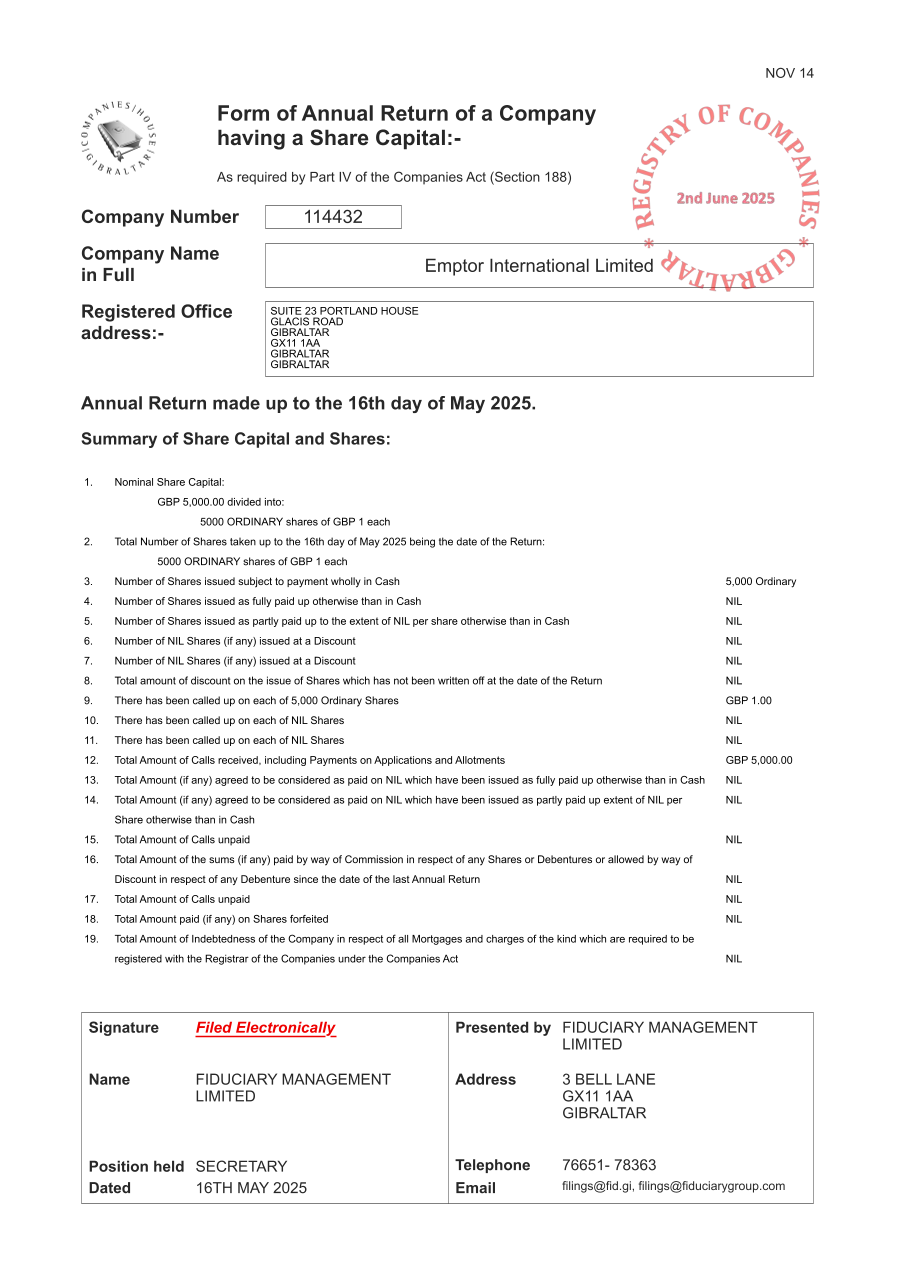
A company with a share capital makes its annual return up to the anniversary of its incorporation and delivers it within 30 days (section 188).1 The return lists the names, addresses and occupations of past and present members, their shares and the transfers since the last return (section 188(4)). It also states the registered office and the share capital (section 188(7)). A collective investment scheme licensed, authorised or deemed authorised under the Financial Services (Collective Investment Schemes) Act 2011, other than a private scheme, need not list its members (section 188(6)).1
A private company reports any change among its members within 30 days, unless it has notified the Registrar under section 18 that it is a collective investment scheme (section 154(1)).1 A company limited by shares, or limited by guarantee with a share capital, reports every allotment of shares within 30 days, unless it has notified the Registrar under section 18 that it is a collective investment scheme (section 86(1)).1
A company limited by shares may not issue share warrants to bearer (section 157(1)). A bearer warrant issued before 21 March 2013 gives no rights until the bearer is entered in the register of members (section 157(3)).1
Beneficial owners
The Register of Ultimate Beneficial Owners is kept under the Register of Ultimate Beneficial Owners, Nominators and Appointors Regulations 2017, made under the Proceeds of Crime Act 2015. It started on 26 June 2017.5 It is a register of its own with its own Registrar, appointed by the Minister (regulations 4 and 5); since 1 September 2026 the Registrar is the Gibraltar Financial Services Commission (Legal Notice 324 of 2026).10 Before that the Registrar was the Finance Centre Director (from 26 June 2017, Legal Notice 121 of 2017) and then persons named by the Minister (from 13 June 2024, Legal Notice 96 of 2024, and from 14 May 2026, Legal Notice 97 of 2026).11, 12, 34
Who must report
Every corporate or legal entity incorporated in Gibraltar reports, including limited partnerships and limited liability partnerships (regulations 3(1) and 8).5 A beneficial owner is the natural person who ultimately owns or controls the entity (regulation 3(1)). For a Listed Entity as defined in section 7(1) of the Proceeds of Crime Act 2015, or a majority-owned subsidiary of one, the beneficial owner is the Listed Entity itself (regulation 3(1), paragraph (a) of the definition). A holding of 25% plus one share, or more than 25% of the ownership interest, indicates ownership (regulation 3(2)).5 Failing such a person, it is the person in control by other means, and then the senior managing official (regulation 3(1)).5
A new entity files within 30 days of incorporation and reports a change within 30 days (regulation 8).5 A person who becomes a beneficial owner tells the entity within 15 days (regulation 8A).5 The information the Registrar may ask for includes the beneficial owner's full name, previous names, date of birth, gender, place of birth, nationality, country of usual residence, usual residential address, service address and occupation, the dates on which the interest was acquired and given up, and how the interest is held, with the percentage (regulation 6(4)).5 Since 27 November 2025, when a beneficial owner is a trust whose trustees have reported it to the Gibraltar Financial Services Commission under the Trusts (Information) Regulations 2025, the entity reports only the name of the trust and the names and contact details of its trustees (regulation 8(6)).5
Who can see it today
On 27 November 2026 any member of the public may ask the Registrar to inspect a company's entry (regulation 26(1)(d)).5 The public sees the beneficial owner's name, month and year of birth, nationality, country of residence and the nature and extent of the interest (regulation 26(4)).5 When an obliged entity or a member of the public asks for or is given access, the Registrar may inform the beneficial owner (regulation 26(5)).5 A copy, certified copy or extract can be requested (regulation 26(6)).5 Nothing is given out more than 10 years after the duty to report ended (regulation 26(8)).5
Competent authorities, the Commissioner of Income Tax and financial intelligence units have access without restriction. Banks and other obliged entities have access for customer due diligence (regulation 26(2) and (3)).5 An obliged entity that finds the information it obtained from the register materially inconsistent with other information it holds reports the inconsistencies to the Registrar within 30 days of discovering them, or a later time agreed with the Registrar (regulation 26A(1)).5 Entries on express trusts are not public (regulation 26(7)).5 In exceptional circumstances, where the beneficial owner is a minor or otherwise incapable, or where access would expose the beneficial owner to a risk of fraud, kidnapping, blackmail, violence or intimidation, the Registrar may refuse access to obliged entities and the public, on an application by the beneficial owner or the entity (regulations 31 and 32(1) and (2)). The Registrar may not refuse access to credit institutions, financial institutions or obliged entities that are public officials (regulation 32(4)).5
The Registrar may charge the public a fee up to the administrative cost and may require online registration (regulations 29(3), 29(4) and 29A).5
How access changed
From the start of the register on 26 June 2017 until 13 March 2020, only a person or organisation that satisfied the Registrar of a legitimate interest could see an entry (regulation 26(1)(d) and (5) as made).6 Since 13 March 2020 any member of the public may ask (Legal Notice 110 of 2020, in force on its publication).7
Legal Notice 147 of 2026, published on 3 July 2026, would have limited access from 15 July 2026 to persons with a legitimate interest in preventing or combating money laundering, its predicate offences, terrorist financing or proliferation financing, among them journalists, civil society organisations and persons likely to enter into a transaction with the entity (its regulation 4(3) and (4), and regulation 26ZZA(1) and (4) that it would have inserted).8 On 14 July 2026 Legal Notice 220 of 2026 removed those provisions and restated public access (its regulations 3 and 4).9 Public access therefore continued without a break.
Financial statements
Part VII of the Companies Act 2014 governs the accounts of mainstream companies: limited companies other than non-profit companies, licensed banks and insurers (section 237(2)).1, 28 The directors deliver the annual accounts, the directors' report and the auditors' report for each financial year (section 254(2)).1 The accounts delivered are signed by two directors, or by the only director (section 254(4)).1 The directors of a company that is not small may instead keep the directors' report available to the public at the registered office, with a copy on request at no more than its administrative cost (section 254(5)).1
A private company files within 12 months after the end of its financial year and a public company within 10 months; for a first financial year the period is 12 months (section 272).1 Accounts filed more than 13 months and up to 24 months after the end of the financial period carry a supplementary fee of GBP 180.50, and accounts filed later a supplementary fee of GBP 309.00 (section 426(4)(b) and Schedule 24).1, 22, 29
Schedule 9 (section 293) classes a company by at least two of three tests.1
Scroll sideways to see all columns.
| Class | Net turnover | Balance sheet total | Employees |
|---|---|---|---|
| Micro-entity | up to GBP 632,000 | up to GBP 316,000 | up to 10 |
| Small | up to GBP 10.2 million | up to GBP 5.1 million | up to 50 |
| Medium-sized | up to GBP 36 million | up to GBP 18 million | up to 250 |
| Large | over GBP 36 million | over GBP 18 million | over 250 |
A company changes class only when it crosses the limits in two consecutive years (paragraph 4(2)). A public company is never micro, small or medium-sized (paragraph 3).1
A small company may deliver only its balance sheet (section 254(6)).1 The register's guidance says that micro and small companies file an abridged balance sheet only, medium-sized companies may abridge the profit and loss account, and large companies file full accounts with both reports.28 Accounts filed with the Registrar are open to inspection (section 427).1
A small company is exempt from audit when it need not file an income tax return, or when its turnover meets the test in section 30(1)(c) of the Income Tax Act 2010 (section 259).1 The rules on the content, audit and filing of a subsidiary's individual accounts (other than accounts under international accounting standards) and of its directors' report do not apply when its parent is subject to the law of Gibraltar, of any part of the United Kingdom or of an EEA State; all its members agree, each financial year; the parent guarantees its commitments; both declarations are delivered to the Registrar; and the parent's consolidated accounts, drawn up under Part VII, include the subsidiary, disclose the exemption and are delivered to the Registrar with the consolidated annual report and the auditors' report (section 270).1
When each member of a partnership formed under Gibraltar law (for a limited partnership, each general partner) is a limited company, or an unlimited company whose members are all limited companies, the members prepare accounts and a report of the members, and have an auditors' report prepared, as if the partnership were a company under Part VII. The directors of an unlimited company incorporated in Gibraltar whose members meet the same test do the same. A member may be a Gibraltar company or a comparable undertaking of another country (regulations 4 to 6 of the Partnerships and Unlimited Companies (Accounts) Regulations 2015, for financial years beginning on or after 1 January 2016).40 Each limited company that is a member appends a copy of those accounts to the next accounts it delivers to the Registrar (regulation 7(1)). When every member has its registered office outside Gibraltar, the accounts are open to inspection by any person, free of charge, at the partnership's head office or the company's registered office in Gibraltar, except in some cases where a member is from an EEA State (regulation 8). These duties do not apply when the partnership or company is dealt with in consolidated group accounts on the conditions of regulation 9.40

Filings
The Companies (Forms) Regulations 2014, in force since 1 November 2014, prescribe forms for the purposes of the Act (regulations 1 and 2).23 Where the register gives a form a name, the table uses that name.30 Sections are of the Companies Act 2014.1
Scroll sideways to see all columns.
| Filing | What it reports | Time limit | Law |
|---|---|---|---|
| Application for Registration | Incorporation, with memorandum, articles, statement of capital and statement of compliance | Before registration | sections 9 to 14 |
| Return of Particulars of Directors, Managers and Secretaries, and of any change therein | First officers, appointments, changes of particulars, resignations | 14 days | sections 222 and 223 |
| Notice of any change of Registered Office | New registered office in Gibraltar | 30 days | section 178 |
| Form of Annual Return of a Company having a Share Capital | Office, capital, members and shares | 30 days after the return date (6 months for a private scheme) | sections 188(2) and (3) and 189 |
| Form of Annual Return of a Company not having a Share Capital | Office, directors, secretaries, debts secured by charges | 28 days after the return date | section 190 |
| Return of Allotment of Shares | Shares allotted and allottees | 30 days | section 86 |
| Return of Members, and of any change therein | Transfers, changes of members and of their particulars | 30 days | section 154 |
| Annual accounts | Accounts and reports | 12 months (private), 10 months (public) | section 272 |
| Change of Accounting Reference Period | A new accounting reference date | For a previous period, before the period for filing its accounts has expired | section 268 |
| Copy of the amended articles | New articles | 30 days | section 26 |
| Resolutions and agreements | Special and other resolutions | 30 days | section 206 |
| Notice of change of name by resolution | New name | 7 days | section 29 |
| Notice of Increase of Share Capital | Capital increased beyond the registered capital | 15 days | section 132 |
| Notice of Consolidation of Share Capital, and the notices of conversion into stock, re-classification, re-conversion, sub-division, redemption and cancellation of shares | Changes to the share capital | 30 days | section 131 |
| Particulars of a Mortgage or Charge | A new charge and its instrument | 30 days from creation | section 168 |
| Declaration verifying Memorandum of Satisfaction of Mortgage or Charge & Memorandum of Satisfaction of Mortgage or Charge | A charge paid or satisfied | Not fixed | section 174 |
| Declaration of Solvency (Voluntary Liquidation) | Debts will be paid | 15 days after the resolution | section 362 |
| Notice of Appointment of Liquidator (Voluntary Liquidation) | The liquidator | 14 days | section 376 |
| Return of Final Winding-up meeting (Voluntary Liquidation) | The final account and the final meeting | 1 week after the meeting | section 397 |
| Striking off Application by Company | Request to be struck off | Not fixed | section 413 |
| Application to Restore a company to the Register | Restoration | Within 10 years of the Gazette notice of striking off | section 414 |
| List of documents delivered to the Registrar of Companies for Registration | Place of business of a body corporate incorporated outside Gibraltar: its constitution, its directors or equivalent officers, and persons resident in Gibraltar authorised to accept service | 1 month | section 432 |
| Application for the Registration of a Branch under Part XIV | A foreign company's branch | 1 month | section 445 |
| Beneficial ownership information (to the Registrar of Ultimate Beneficial Owners) | Beneficial owners | 30 days | regulation 8, beneficial owners regulations |
Active directors and secretaries can also file some documents through the register's optional e-Filing service, among them annual accounts, annual returns, changes of registered office and of directors and secretaries, and striking off applications.32
If a company files no annual return, the Registrar may treat that as cause to believe that it is not carrying on business or not in operation (section 191(3)(b)). That is the ground on which the Registrar may begin to strike it off under section 412 (company status).1
Documents and certificates
Certified copies
Any person may obtain a copy, certified copy or extract of any record of the Registrar (section 427(1) of the Companies Act 2014).1 Electronic certified copies carry the Registrar's electronic signature (section 428).1 Any person may also obtain a certificate of incorporation of a company, signed by the Registrar or authenticated by the Registrar's official seal (section 427(5)).1
Company profile
Any member of the public can request a company profile.27 It summarises the number, name, date of incorporation, last annual return, last accounts, registered office, status, share capital, shareholders, directors, secretary and charges. A certified profile is certified by the Registrar.27 A mortgage profile lists the charges.25
Certificate of good standing
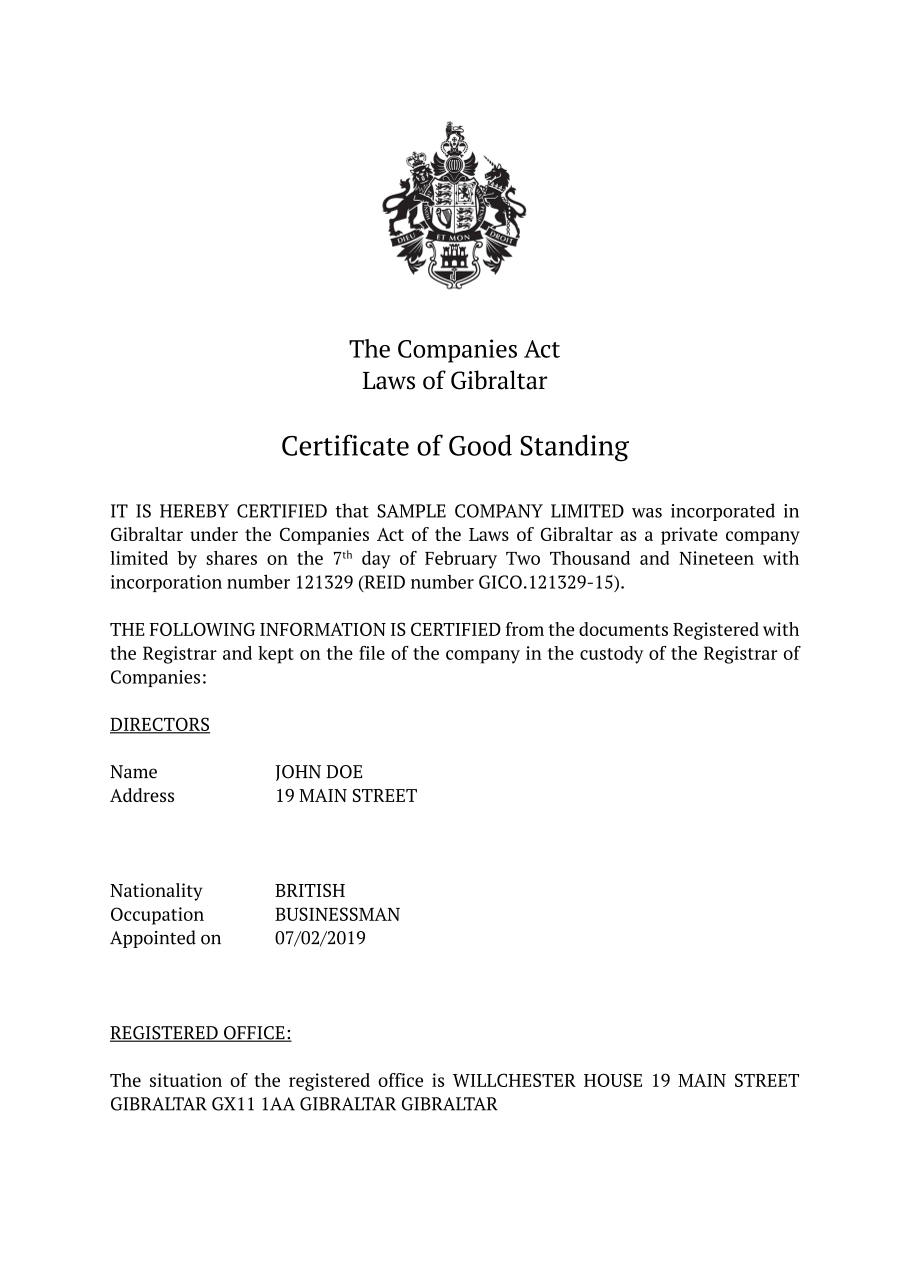
Anyone may request a certificate of good standing. It is issued only for a company up to date with all its filings.26 It states the name and number, the current officers and their addresses, the registered office, the share capital and the charges registered at Companies House. It confirms that the company is not being dissolved, liquidated or struck off. Its details are those of the Registrar's records on the date of issue. An officer may ask for a long form that adds the shareholders, as given in the list of members the officer submits, except for a public limited company. No certificate is issued for Part XII or Part XIV registrations.26
Apostille
The Government of Gibraltar's guidance names the Department of Immigration and Home Affairs as the only competent authority in Gibraltar for issuing apostilles. It says that, to be accepted for an apostille, a document must be signed by a notary public approved by HM Government of Gibraltar.31 Since 11 July 2025 the Civil Status (Miscellaneous Amendments) Act 2025 has put the department in place of the Civil Status and Registration Office in the laws it amends (sections 3 to 14).38 The Hague Conference's list of competent authorities still names the Civil Status and Registration Office (on behalf of the Governor of Gibraltar).39 An apostille certifies the authenticity of the signature, the capacity in which the signer acted and, where appropriate, the identity of the seal or stamp the document bears (articles 3 and 5 of the Hague Convention of 5 October 1961 Abolishing the Requirement of Legalisation for Foreign Public Documents).37
Charges and mortgages
A company delivers the particulars of a charge, with its instrument, within 30 days of its creation (section 168(1) of the Companies Act 2014).1 An unregistered charge is void against the liquidator and creditors, and the money it secures becomes payable at once (section 168(1) and (2)).1 The rule covers charges securing an issue of debentures and charges on land, book debts, ships, goodwill and intellectual property, uncalled capital, and floating charges, created in or outside Gibraltar (section 168(3)).1 Section 168 does not apply to a charge that is a registered international interest under the International Interests in Aircraft Equipment (Cape Town Convention) Regulations 2015 (section 168A).1 The company register shows only the charges registered with the Registrar under the Companies Act 2014.
The Registrar's register of charges records the date, the amount secured, short particulars of the property and the persons entitled (section 172(1)).1 Any person may inspect it for a fee (section 172(3)).1 The Registrar's certificate of registration states the amount secured and is conclusive evidence that the requirements for registering the charge have been complied with (section 172(2)).1 When satisfied that the debt secured by a registered charge has been paid or satisfied, the Registrar may order a memorandum of satisfaction to be entered on the register (section 174).1 Every limited company also keeps its own register of charges at its registered office (section 177(1)).1
Some security is also recorded in other registers, in addition to the registration of the charge with the Registrar that section 168 requires. Every deed that affects or relates to land in Gibraltar must be registered in the Land Titles Register (section 3 of the Gibraltar Land Titles Act 2011).35 Mortgages of Gibraltar-registered ships produced to the Maritime Administrator are recorded in the index of the register of ships (section 39 of the Gibraltar Merchant Shipping (Registration) Act 1993).36
Company status
The register shows the status of a company, for example in liquidation, pending striking off or struck off.27
Striking off
The Registrar may strike off a company, other than a public limited company, that has filed no annual return in the previous three calendar years. The Registrar gives three months' notice in the Gazette (section 411 of the Companies Act 2014).1 The Registrar may also strike off a company when there is reasonable cause to believe that it is not carrying on business, after a letter, one month's wait and a notice in the Gazette that, unless cause is shown, the company will be struck off and dissolved three months later (section 412).1 A company with no assets or liabilities may ask to be struck off: its directors, or a majority of them, apply in writing, and the Registrar may strike it off once three months have passed since a notice in the Gazette (section 413(2) and (3)).1
The company is dissolved when the striking off is published. The liability of its directors, managing officers and members continues and may be enforced as if the company had not been dissolved (sections 412(5) and 413(5)).1 Its remaining property is bona vacantia and passes to the Crown (section 416(1)).1
Restoration
The company, a member or a creditor may ask the Registrar to restore a struck-off company within 10 years (section 414(1)). The Registrar first publishes a notice in the Gazette and allows 30 days for written objections (section 414(4)). A restored company is treated as having continued in existence (section 414(9)).1 After 10 years, restoration goes through the court (section 415(6)).1
Liquidation
A solvent company is wound up by voluntary liquidation under Part X. The directors declare that the debts will be paid within at most 12 months (section 362).1 The declaration has effect only if it is made within the five weeks before the resolution to appoint a voluntary liquidator, or on that day before the resolution is passed, and includes a statement of the company's assets and liabilities (section 362(2)).1 It is delivered to the Registrar within 15 days after the winding-up resolution (section 362(3)).1 The liquidation begins when the company appoints a voluntary liquidator by resolution (section 363), and the liquidator files notice of the appointment within 14 days (section 376).1 Within one week after the final meeting, the liquidator sends the Registrar a copy of the final account and a return of the meeting (section 397(3)). The company is deemed dissolved three months after the Registrar registers the return, unless the court defers the date (section 397(5) and (6)).1
Insolvent companies fall under the Insolvency Act 2011, in force since 1 November 2014: administration, receivership, liquidation, voluntary arrangements with creditors and cross-border insolvency.4
Legislation
Laws in force
- Companies Act 2014 (Act 19 of 2014): formation, constitution, capital, charges, officers, annual returns, accounts and audit, solvent liquidation, striking off, the Registrar and foreign bodies corporate. In force since 1 November 2014.1
- Insolvency Act 2011: administration, receivership and liquidation of companies, arrangements with creditors and cross-border insolvency. In force since 1 November 2014.4
- Register of Ultimate Beneficial Owners, Nominators and Appointors Regulations 2017. In force since 26 June 2017.5
- Companies (Forms) Regulations 2014: the prescribed forms. In force since 1 November 2014.23
- Companies (Re-Domiciliation) Regulations 1996: re-domiciliation into and out of Gibraltar. In force since 29 February 1996, for applications made on or after 1 March 1996.21
- Protected Cell Companies Act 2001, Limited Partnerships Act 2021, Limited Liability Partnerships Act 2009, Private Foundations Act 2017 and the Business Names Registration Act of 1918.17, 14, 16, 19, 20
Timeline
- 1 June 1928: the Limited Partnerships Act of 1927 comes into force.15
- 1930: the Companies Act of 1930 is enacted. It is repealed from 1 November 2014, except one section.2
- 1993: the Government decides to hand the day-to-day management of the registry to a private company.24
- 29 February 1996: the Companies (Re-Domiciliation) Regulations 1996 come into force. They apply to applications made on or after 1 March 1996 (regulation 1(1)).21
- 1 April 2000: the Companies (Accounts) Act 1999 comes into force. It is repealed from 1 November 2014.3
- 1 November 2001: protected cell companies are introduced.17
- 1 November 2014: the Companies Act 2014 and the Insolvency Act 2011 come into force.1, 4
- 24 March 2016: limited liability partnerships become available.16
- 11 April 2017: the Private Foundations Act 2017 comes into force.19
- 26 June 2017: the register of beneficial owners starts.5
- 5 September 2019: the Companies (Amendment) Act 2019 extends Parts XII and XIV, on places of business and branches in Gibraltar of bodies incorporated elsewhere, from companies to bodies corporate, meaning any entity having a legal personality.1, 41
- 13 March 2020: the register of beneficial owners opens to the public.7
- 25 November 2021: the Limited Partnerships Act 2021 replaces the Act of 1927.14, 15
- 1 March 2024: new registry fees (Legal Notice 299 of 2023).1
- 1 August 2025: new registry fees, the latest amendment listed in the consolidated Companies Act 2014.1, 22
- 14 July 2026: a planned limit on public access to beneficial owners is withdrawn before it takes effect.9
- 30 July 2026: protected cell companies may issue tokenised shares.18
- 1 September 2026: the Gibraltar Financial Services Commission becomes Registrar of Ultimate Beneficial Owners.10
Questions
Who keeps the company register in Gibraltar?
The Registrar of Companies, appointed under section 420 of the Companies Act 2014, keeps it. The registry is Companies House Gibraltar, whose day-to-day management the Government decided in 1993 to hand to a private company; Companies House (Gibraltar) Limited manages it.
Is the Gibraltar company register public?
Yes. Under section 427 of the Gibraltar Companies Act 2014, any person may inspect the records at Companies House Gibraltar and obtain copies or certified copies. The records include directors, members, share capital, accounts and charges.
Can I find the directors of a Gibraltar company?
Yes. Gibraltar companies report their directors and secretary to Companies House Gibraltar within 14 days of any change (section 222 of the Companies Act 2014). The returns give names, residential address, nationality and occupation, and are open to inspection (section 427).
Can I find the shareholders of a Gibraltar company?
Usually yes. A Gibraltar company with a share capital lists its members in its annual return to Companies House Gibraltar (section 188). A private company also reports changes of members within 30 days (section 154). A collective investment scheme licensed, authorised or deemed authorised under the Financial Services (Collective Investment Schemes) Act 2011, other than a private scheme, need not list its members (section 188(6)). A private company that has notified the Registrar that it is a collective investment scheme need not report changes of members (section 154(1)).
Who can see the beneficial owners of a Gibraltar company?
Since 13 March 2020 any member of the public may ask the Gibraltar Registrar of Ultimate Beneficial Owners, since 1 September 2026 the Gibraltar Financial Services Commission, for a company's entry. The public sees the name, month and year of birth, nationality, country of residence and the nature and extent of the interest held (regulation 26(4) of the Register of Ultimate Beneficial Owners, Nominators and Appointors Regulations 2017). The other details go only to the authorities and, for customer due diligence, to obliged entities. This register is separate from Companies House Gibraltar.
Did Gibraltar restrict access to beneficial owners in 2026?
No. A change to legitimate-interest access, due on 15 July 2026, was withdrawn on 14 July 2026 by Legal Notice 220 of 2026. The Gibraltar register of beneficial owners, separate from Companies House Gibraltar, stays open to the public.
Do Gibraltar companies file accounts?
Limited companies do, with exceptions. Gibraltar limited companies, other than non-profit companies, licensed banks and licensed insurers, deliver their accounts to Companies House Gibraltar under Part VII of the Companies Act 2014 (sections 237(2) and 254). Private companies file within 12 months of the year end and public companies within 10 months (section 272). A small company may file only its balance sheet (section 254(6)).
How do I get a certificate of good standing for a Gibraltar company?
Anyone may request one from Companies House Gibraltar. It is issued only for a company up to date with its filings, and shows the officers, office, share capital and charges. It confirms that the company is not being dissolved, liquidated or struck off.
Who issues apostilles in Gibraltar?
Companies House Gibraltar issues certificates and certified copies, but not apostilles. The Government of Gibraltar's guidance names the Department of Immigration and Home Affairs, formerly the Civil Status and Registration Office, as the only competent authority in Gibraltar for issuing apostilles.
What happens to a Gibraltar company that stops filing annual returns?
Under section 411 of the Gibraltar Companies Act 2014, the Registrar may strike off a company, other than a public limited company, that has filed no annual return in the previous three calendar years, after a three-month notice in the Gazette. The Registrar at Companies House Gibraltar can restore it within 10 years on an application by the company, a member or a creditor (section 414), and after that the court can (section 415(6)).
Where does a Gibraltar company number appear?
Every Gibraltar company receives a registered number when Companies House Gibraltar incorporates it. The number appears on its certificate of incorporation (section 15(2) of the Companies Act 2014). The company also shows it, with its place of registration and registered office, on its letters, order forms and website home page (section 180).
Sources
- Companies Act 2014 (Act 19 of 2014), consolidated version of 1 August 2025, sections 2 to 5, 9 to 15, 18, 19, 26, 28, 29, 86, 131, 132, 135, 154, 157, 168, 168A, 169 to 191, 206, 215, 216, 219, 222, 223, 237, 254, 259, 268, 270, 272, 293, 362 to 397, 411 to 416, 420 to 428, 432, 442 to 445, Schedules 9 and 24 and the table of amending enactments. Read on 27 November 2026.
- Companies Act (Act 7 of 1930), note of repeal. Read on 16 November 2026.
- Companies (Accounts) Act 1999, notes of commencement and repeal. Read on 16 November 2026.
- Insolvency Act 2011, long title and commencement. Read on 27 November 2026.
- Register of Ultimate Beneficial Owners, Nominators and Appointors Regulations 2017 (Legal Notice 122 of 2017), version of 15 July 2026, regulations 2 to 8A, 26 to 32. Read on 27 November 2026.
- The same regulations, version of 26 June 2017 (as made) and version of 5 April 2018, regulation 26. Read on 16 November 2026.
- Proceeds of Crime Act 2015 (Amendment) Regulations 2020 (Legal Notice 110 of 2020). Read on 16 November 2026.
- Proceeds of Crime (Amendment) Regulations 2026 (Legal Notice 147 of 2026), regulations 2 and 4, as made. Read on 27 November 2026.
- Register of Ultimate Beneficial Owners, Nominators and Appointors (Amendment) Regulations 2026 (Legal Notice 220 of 2026), regulations 2 to 4. Read on 16 November 2026.
- Notice of Appointment of Registrar of Ultimate Beneficial Owners (Legal Notice 324 of 2026). Read on 16 November 2026.
- Notice of Appointment of Registrar of Ultimate Beneficial Owners (Legal Notice 121 of 2017). Read on 16 November 2026.
- Notice of Appointment of Registrar of Ultimate Beneficial Owners (Legal Notice 96 of 2024). Read on 16 November 2026.
- Appointment of Registrar of Companies (Government Notice 287 of 2026). Read on 27 November 2026.
- Limited Partnerships Act 2021, sections 5, 6 and 10 and commencement. Read on 27 November 2026.
- Limited Partnerships Act (1927), notes of commencement and repeal. Read on 27 November 2026.
- Limited Liability Partnerships Act 2009, section 3 and commencement. Read on 16 November 2026.
- Protected Cell Companies Act 2001, section 3 and commencement. Read on 16 November 2026.
- Protected Cell Companies (Amendment) Act 2026 and its notice of commencement (Legal Notice 294 of 2026). Read on 16 November 2026.
- Private Foundations Act 2017, sections 11 and 12 and commencement. Read on 27 November 2026.
- Business Names Registration Act, section 2A and commencement. Read on 27 November 2026.
- Companies (Re-Domiciliation) Regulations 1996 (Legal Notice 24 of 1996), regulation 1 and commencement. Read on 27 November 2026.
- Companies Act (Fees) (Amendment) Regulations 2025 (Legal Notice 211 of 2025). Read on 27 November 2026.
- Companies (Forms) Regulations 2014 (Legal Notice 193 of 2014), regulations 1 and 2. Read on 27 November 2026.
- Companies House Gibraltar, Guidance Note 1, the registry brochure, updated January 2018, pages 1, 3 and 4. Read on 27 November 2026.
- Companies House Gibraltar, Guidance Note 5, Searches, updated August 2025, the statutory functions, "e-Search" and "Company Mortgage Profile". Read on 18 November 2026.
- Companies House Gibraltar, Guidance Note 7, Certificate of Good Standing, updated August 2025, pages 1 and 2. Read on 18 November 2026.
- Companies House Gibraltar, Guidance Note 8, Profiles, updated August 2025, pages 1 and 2. Read on 18 November 2026.
- Companies House Gibraltar, Guidance Note 25, Filing of Accounts, updated August 2025, page 1. Read on 18 November 2026.
- Companies House Gibraltar, Guidance Note 19, Table of Fees, updated August 2025, the supplementary fees for late accounts. Read on 27 November 2026.
- Companies House Gibraltar, forms for companies under the Companies Act 2014, by subject. Read on 18 November 2026.
- Department of Immigration and Home Affairs, HM Government of Gibraltar, Request for an Apostille, with guidance notes, and the department's Apostille page. Read on 18 November 2026.
- Companies House Gibraltar, Guidance Note 39, e-Registry and e-Filing, "The e-Registry", items i and ii, and "e-Filing Service". Read on 27 November 2026.
- Companies House Gibraltar, Important Notice of 18 February 2026, "Companies House Gibraltar Announces Launch of Online Incorporation Service". Read on 18 November 2026.
- Notice of Appointment of Registrar of Ultimate Beneficial Owners (Legal Notice 97 of 2026). Read on 16 November 2026.
- Gibraltar Land Titles Act 2011 (Act 6 of 2011), sections 2 and 3. Read on 16 November 2026.
- Gibraltar Merchant Shipping (Registration) Act 1993 (Act 12 of 1995), sections 6 and 39. Read on 16 November 2026.
- Hague Conference on Private International Law, Convention of 5 October 1961 Abolishing the Requirement of Legalisation for Foreign Public Documents, articles 3 and 5. Read on 16 November 2026.
- Civil Status (Miscellaneous Amendments) Act 2025 (Act 3 of 2025), sections 3 to 15, and its notice of commencement (Legal Notice 146 of 2025). Read on 18 November 2026.
- Hague Conference on Private International Law, United Kingdom, Competent Authority (Art. 6) of the Apostille Convention, entry for Gibraltar, page last updated on 7 May 2026. Read on 18 November 2026.
- Partnerships and Unlimited Companies (Accounts) Regulations 2015 (Legal Notice 114 of 2015), regulations 2 and 4 to 9. Read on 27 November 2026.
- Companies (Amendment) Act 2019 (Act 33 of 2019), sections 2 to 4. Read on 27 November 2026.
New in the register
This guide was reviewed on 27 November 2026 against the laws in its sources list. It is general information and not legal advice. Dato Capital is a private company; it is not Companies House Gibraltar and does not act for it.